




by Eric Marshall, CFA, on Jan 27, 2026
The whole problem with the world is that fools and fanatics are always so certain of themselves, and wiser people so full of doubts.
– Bertrand Russell, 1933
U.S. markets were mixed in the final quarter of 2025; however, most major indices closed the year with double-digit gains despite numerous headwinds from geopolitical tensions, tariff uncertainty, a mixed economic backdrop, and the longest government shutdown in U.S. history. For the third year in a row, large-cap growth stocks, especially technology and AI-related names, led the bull market. However, strength extended beyond the magnificent seven mega-cap tech stocks in 2025 to a broader number of financials, industrials, and healthcare stocks that participated in the second half of the year. Small and mid-cap stocks also rallied in the second half of 2025 in the wake of three interest rate cuts and resilient corporate earnings. The S&P 500 rose 2.66% in the recent quarter, resulting in a total gain of 17.88% in 2025. The S&P 500 Equal Weight Index increased by only 2.38% and 11.21% in the recent quarter and year, respectively. Small-cap stocks, as measured by the Russell 2000, ended the year with a gain of 12.8%. Sector performance within small-cap stocks was mixed in 2025, with a leadership rotation into speculative technology and biotech stocks in the final months of the year. Financials, industrials, technology, and communication services experienced substantial gains, while energy, consumer discretionary, and housing-related stocks lagged throughout much of the year.
Returns (% Retail Class) as of 12/31/2025
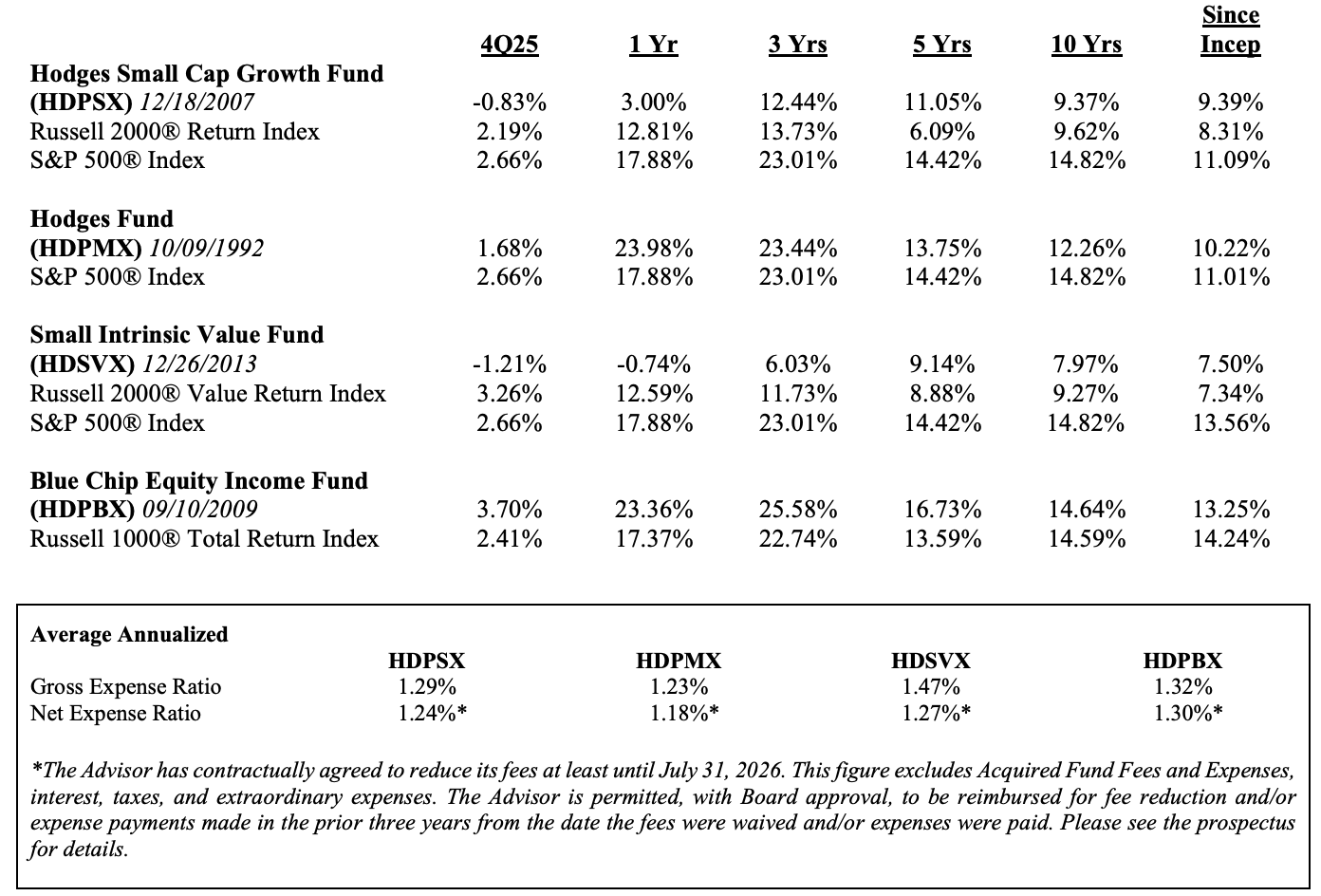
Performance data quoted represents past performance and does not guarantee future results. The investment return and principal value of an investment will fluctuate so that an investor's shares, when redeemed, may be worth more or less than their original cost. The current performance of the Funds may be lower or higher than the performance quoted. Performance data current to the most recent month-end may be obtained by calling 866-811-0224. The Funds impose a 1.00% redemption fee on shares held for thirty days or less (60 days or less for Institutional Class shares). Performance data quoted does not reflect the redemption fee. If reflected, total returns would be reduced. Performance reflected is net of all other fees and expenses.
Hodges Small Cap Growth Fund (HDPSX)
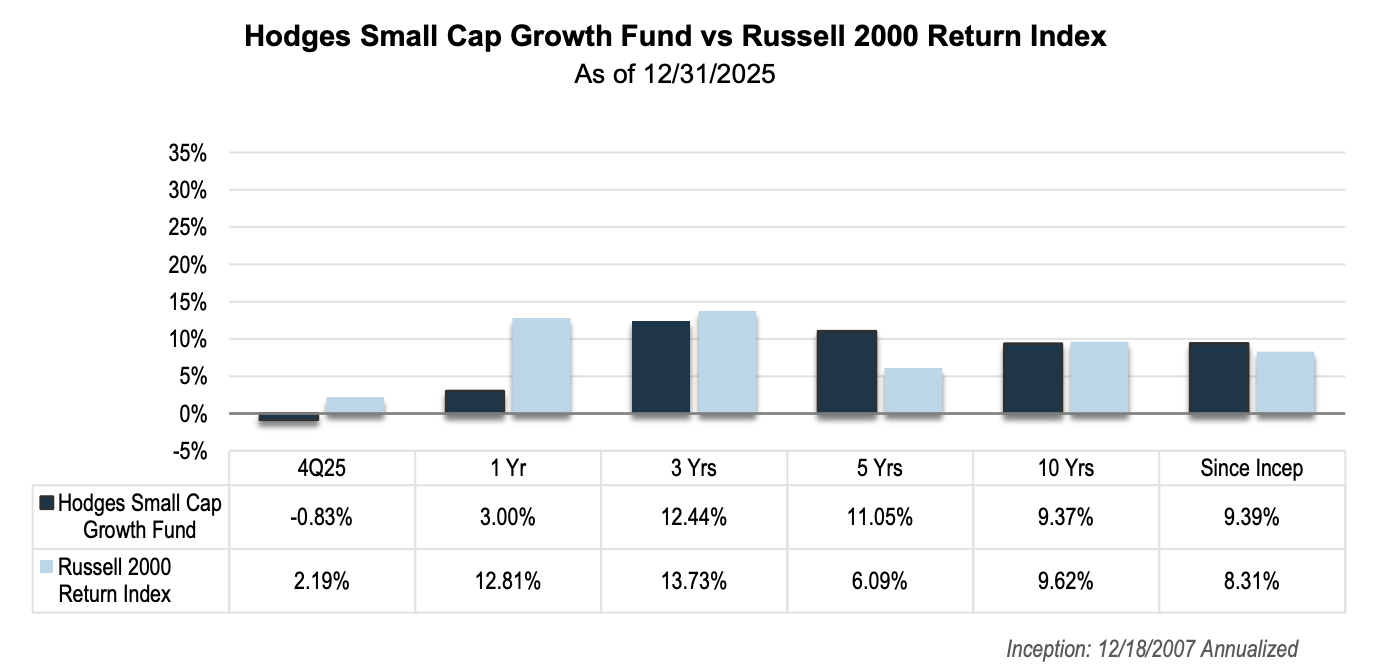
The return for the Hodges Small Cap Growth Fund amounted to a loss of 0.83% in the fourth quarter of 2025, compared to a 2.19% gain for the Russell 2000 Index. The Small Cap Growth Fund's year-to-date performance as of December 31, 2025, amounted to a gain of 3.00% compared to a gain of 12.81% for the Russell 2000 Index during the same period. Underperformance in the recent quarter and year reflected the funds lack of exposure to healthcare biotech, and enterprise technology stocks, which were the strongest contributors to the Russell 2000 performance in 2025. Although small-cap stocks have underperformed large-cap stocks for the better part of the past decade, we still consider the current risk-reward for holding quality small-cap stocks to be attractive. While small-cap stocks tend to experience greater volatility during market turmoil, we expect this segment to generate above-average relative riskadjusted returns over the long term. Furthermore, many small-cap companies are uniquely positioned to benefit from deregulation, a pick-up in M&A activity, AI productivity enhancements, and the reshoring of manufacturing activity in the year ahead.
The Hodges Small Cap Growth Fund remains well diversified across industrials, transportation, technology, and consumer-related names, which we expect to contribute to the Fund's long-term performance. The Fund recently took profits in several stocks that appeared overvalued relative to their underlying fundamentals and established new positions with an attractive risk/reward profile. The Fund held a total of 43 positions as of December 31, 2025. The top ten holdings amounted to 38.08% of the Fund's holdings and included Terawulf Inc (WULF), Matador Resources (MTDR), Cleveland-Cliffs Inc (CLF), Eagle Materials Inc (EXP), Genius Sports Ltd (GENI), Banc of California Inc (BANC), Gildan Activewear Inc (GIL), Texas Cap Bancshares Inc (TCBI), Commercial Metals Company (CMC), and Bank Ozk (OZK).
Hodges Fund (HDPMX)
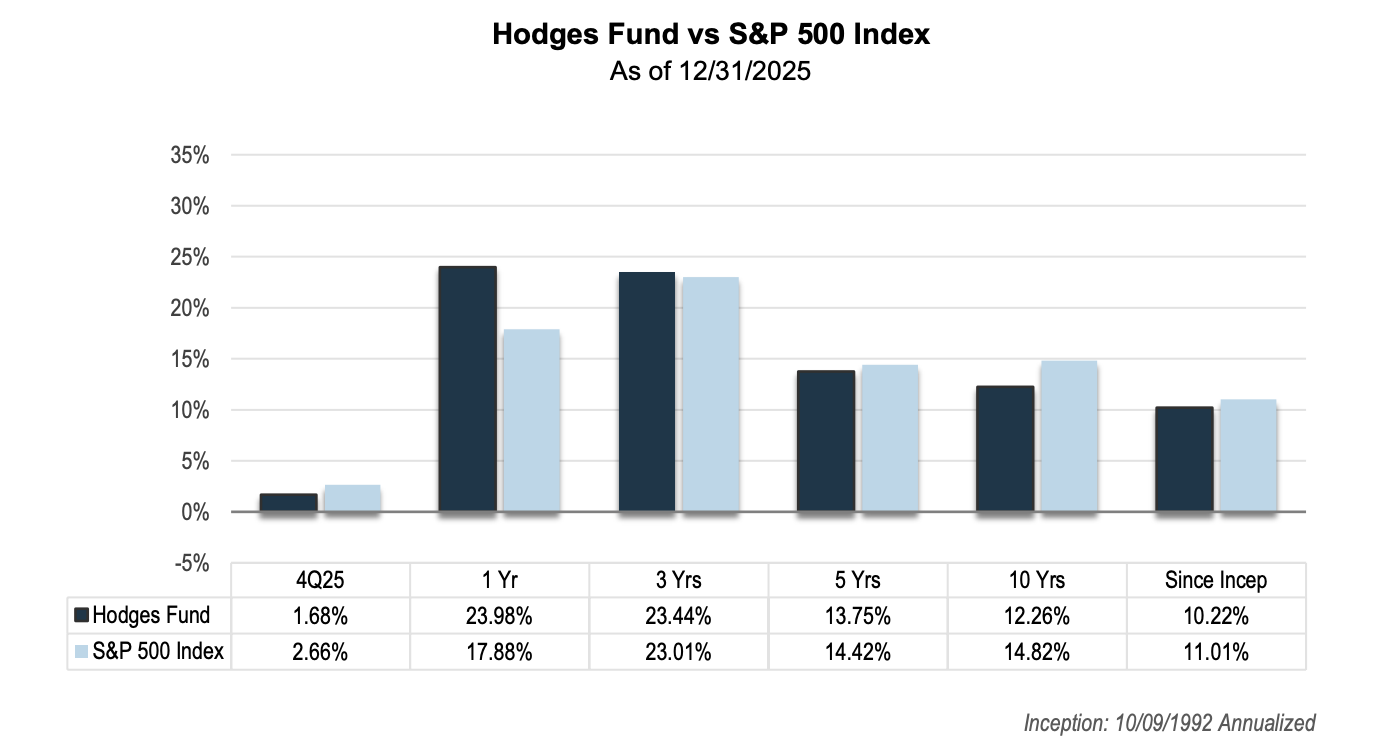
The return for the Hodges Fund amounted to a gain of 1.68% in the fourth quarter of 2025, compared to a 2.66% gain for the S&P 500 Index. In 2025, the Fund generated a return of 23.98%, outperforming the S&P 500's 17.88%. This performance reflects strength in individual holdings within a concentrated portfolio, with several key stocks rising more than doubling in 2025, including Terawulf (WULF), Carpenter Technologies (CRS), and Micron Technologies (MU). Elevated portfolio turnover enabled timely updates to holdings, targeting companies with above-average return potential relative to downside risks over the next 12 to 18 months.
The Hodges Fund's portfolio managers remain focused on investments where we have the highest conviction based on fundamentals and relative valuations. The number of positions held in the Fund at the end of the recent quarter was 40. As of December 31, 2025, the top ten holdings accounted for 46.36% of the Fund's assets. They included Uber Technologies (UBER), Terawulf Inc (WULF), DraftKings Inc. (DKNG), SharkNinja, Inc. (SN), FreeportMcMoRan (FCX), Palantir Technologies Inc (PLTR), Micron Technology Inc (MU), On Holding (ONON), Genius Sports Ltd (GENI), and Matador Resources Co. (MTDR).
Hodges Small Intrinsic Value Fund (HDSVX)
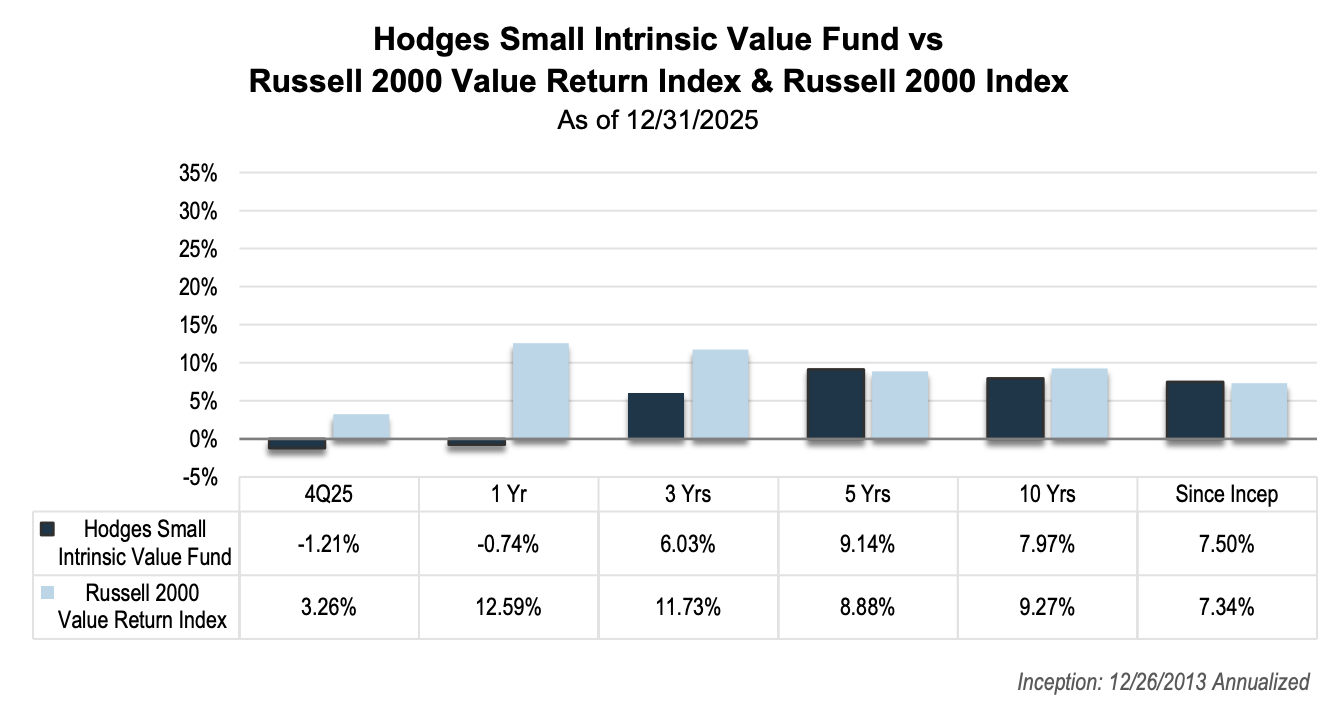
The Hodges Small Intrinsic Value Fund experienced a loss of 1.21 % in the fourth quarter of 2025 compared to an increase of 3.26% for its benchmark, the Russell 2000 Value Index. The Small Intrinsic Value Fund's year-to-date performance as of December 31, 2025, amounted to a loss of 0.74% compared to an increase of 12.59% for the Russell 2000 Value Index during the same period. The Fund's underperformance in both the fourth quarter and year relative to the benchmark has been due to weakness in consumer discretionary, materials, and energy stocks held in the porfolio. Lack of exposure to healthcare and biotech stocks also weighed on the portfolio’s relative performance. The number of positions held in the Fund at the end of the recent quarter was 42. As of December 31, 2025, the top holdings represented 38.83% of the Fund's assets. They included Academy Sports & Outdoors (ASO), Banc of California Inc (BANC), Bank Ozk (OZK), Gulfport Energy Operating Corp (GPOR), Eagle Materials Inc (EXP), Texas Capital Bancshares (TCBI), Commercial Metals Company (CMC), Cleveland-Cliffs Inc (CLF), Haverty Furniture (HVT), and Shoe Carnival Inc (SCVL).
Hodges Blue Chip Equity Income Fund (HDPBX)
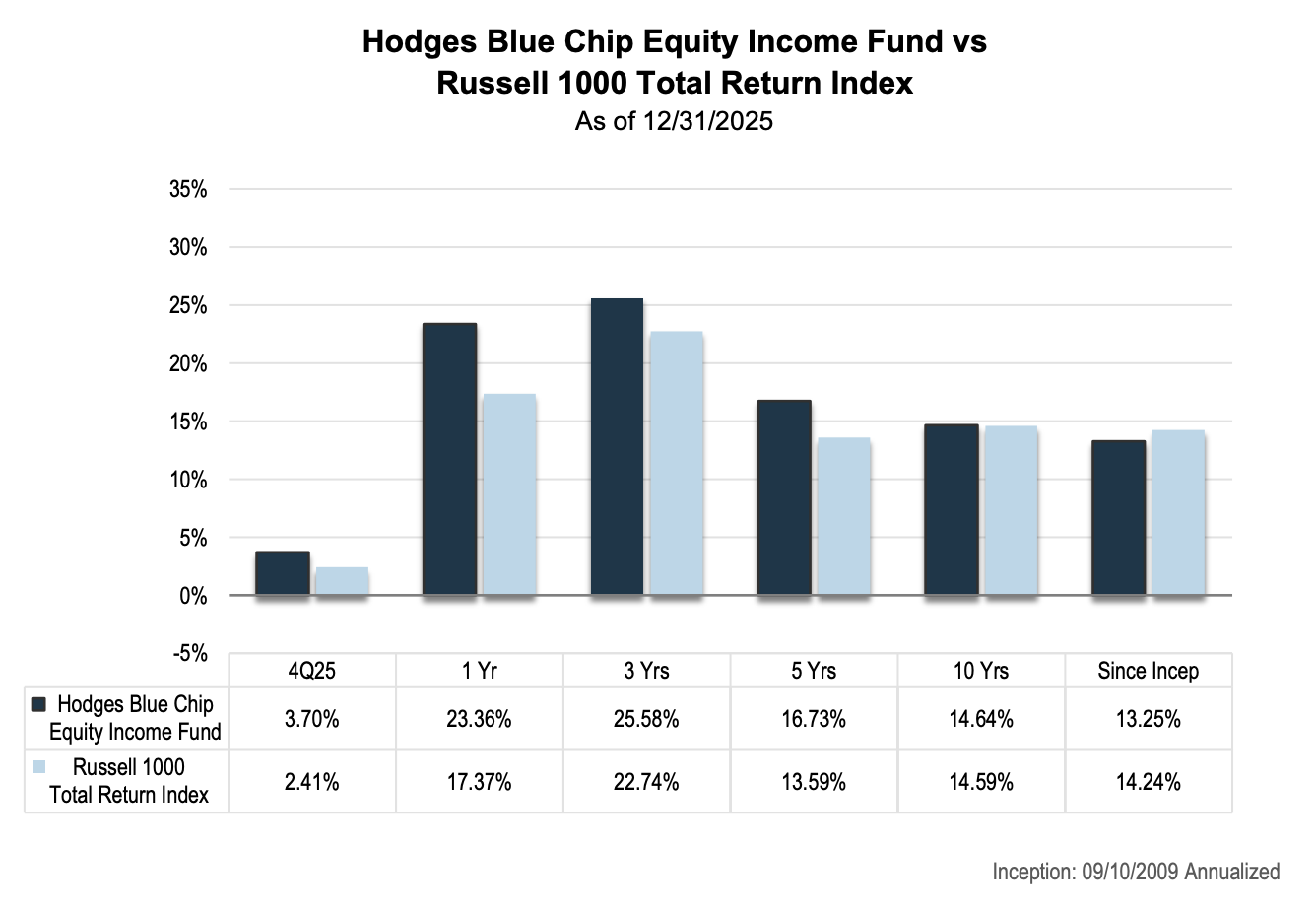
The Hodges Blue Chip Equity Income Fund experienced a 3.70% increase in the fourth quarter of 2025, compared to a 2.41% increase for its benchmark, the Russell 1000 Total Return Index. The Blue Chip Fund's year-to-date performance as of December 31, 2025, was a gain of 23.36%, compared to an increase of 17.37% for the Russell 1000 Index during the same period. Positive relative performance in the recent quarter was attributed to stock selection and sector allocation. We believe the current investment landscape offers ample opportunities among highquality, dividend-paying stocks with solid upside potential. We expect underleveraged balance sheets and robust corporate profits across most blue-chip stocks to support stable dividend yields over the next several years. The Blue Chip Equity Income Fund remains well-diversified in companies that we believe can generate above-average income and total returns on a risk-adjusted basis. The number of positions held in the Fund at the end of the recent quarter was 29. The top ten holdings at the end of the quarter represented 46.83% of the Fund's holdings and included Nvidia (NVDA), Broadcom Inc (AVGO), Apple Inc (AAPL), Walmart Inc (WMT), Citigroup Inc (C), American Express Co (AXP), Taiwan Semiconductor (TSM), Microsoft Corp (MSFT), Goldman Sachs Group Inc (GS), and Wells Fargo Company (WFC).
In conclusion, we remain optimistic about the long-term investment opportunities surrounding the Hodges Mutual Funds. With four distinct mutual fund strategies that cover most segments of the domestic equity market, we are wellpositioned to meet the diverse needs of financial advisors and individual investors. Our dedicated investment team continues to rigorously analyze companies, engage with management teams, and monitor market trends to navigate the ever-changing economic landscape. If you have any specific questions, please don't hesitate to contact us directly.
Learn more about Hodges Funds:
 |
 |
|||
 |
 |
The above discussion is based on the opinions of Eric Marshall, CFA, and is subject to change. It is not intended to be a forecast of future events, a guarantee of future results, and is not a recommendation to buy or sell any security. Portfolio composition and company ownership in the Hodges Funds are subject to daily change.
The Fund’s investment objectives, risks, charges and expenses must be considered carefully before investing. The statutory and summary prospectuses contain this and other important information about the Hodges Funds, and it may be obtained by calling 866-811-0224, or visiting hodgescapital.com/mutual-funds. Read it carefully before investing.
Mutual fund investing involves risk. Principal loss is possible. Investments in foreign securities involve greater volatility and political, economic and currency risks and differences in accounting methods. These risks are greater for investments in emerging markets. Options and future contracts have the risks of unlimited losses of the underlying holdings due to unanticipated market movements and failure to correctly predict the direction of securities prices, interest rates and currency exchange rates. These risks may be greater than risks associated with more traditional investments. Short sales of securities involve the risk that losses may exceed the original amount invested. Investments in debt securities typically decrease in value when interest rates rise. This risk is usually greater for longer term debt securities. Investments in small and medium capitalization companies involve additional risks such as limited liquidity and greater volatility. Funds that are non-diversified are more exposed to individual stock volatility than a diversified fund. Investments in companies that demonstrate special situations or turnarounds, meaning companies that have experienced significant business problems but are believed to have favorable prospects for recovery, involve greater risk.
Value investing carries the risk that the market will not recognize a security’s inherent value for a long time, or that a stock judged to be undervalued may be appropriately priced or overvalued.
Diversification does not assure a profit or protect against a loss in a declining market.
Fund holdings and/or sector allocations are subject to change at any time and are not recommendations to buy or sell any security.
Investment performance reflects fee waivers in effect. In the absence of such waivers, total return would be reduced.
The S&P 500 Index is a broad-based unmanaged index of 500 stocks that is widely recognized as representative of the equity market in general. The Russell 1000 Total Return Index is a subset of the Russell 3000 Index and consists of the 1,000 largest companies comprising over 90% of the total market capitalization of all listed stocks. The Russell 2000 Index consists of the smallest 2,000 companies in a group of 3,000 US companies in the Russell 3000 Index, as ranked by market capitalization. The Russell 2500 Index consists of the smallest 2,500 companies in a group of 3,000 US companies in the Russell 3000 Index, as ranked by market capitalization. The Russell 3000 Index is a stock index consisting of the 3000 largest publicly listed companies, representing about 98% of the total capitalization of the entire US stock market. You cannot invest directly in an index. The Russell 2000 Value Index measures the performance of the small-cap value segment of the US equity universe. It includes those Russell 2000 companies with lower price-to-book ratios and lower forecasted growth values. The Russell 2000 Value Index is constructed to provide a comprehensive and unbiased barometer for the small-cap value segment. The Index is completely reconstituted annually to ensure larger stocks do not distort the performance and characteristics of the true small-cap opportunity set and that the represented companies continue to reflect value characteristics.
Cash Flow: A revenue or expense stream that changes a cash account over a given period.
Price/earnings (P/E): The most common measure of how expensive a stock is.
Earnings Growth is not a measure of the Fund’s future performance.
Hodges Capital Management is the Advisor to the Hodges Funds.
The Hodges Funds are distributed by Northern Lights Distributors, LLC.